
Creating playful experiences is our job and passion.
We enjoy experimenting, designing, and trying new things to continuously improve our virtual experiences. The combination of immersive technology and storytelling is a fascinating field. We pursue the goal of creating intense and emotional experiences that leave a impression on the audience.
We don't just want to convey messages and content – we want to make them truly experiential.
Challenge & Objectives
How can messages and content be made more experiential?
This is a question we deal with regularly. One answer can be found in free-roam experiences, which can be enjoyed in dedicated VR locations or exhibitions. Free-roam experiences allow users to move through virtual space by physically walking in the real world, which makes the experience feel much more present. Since our clients usually have limited physical space and budget, the question is: how can such experiences be created on a smaller scale and with less technical effort?
We took on this challenge and began developing our showcase project Vertical.
The goal of this project is to create a walkable virtual experience on just a 3x3 Meters footprint that can be operated with minimal technical effort. This makes it suitable for quick and mobile deployment, for example at trade fairs, roadshows, or events. Additionally, the experience gained during project development will serve as a conceptual and technological foundation, enabling us to offer our clients tailored free-roam solutions.
Concept Development
Technology
For the technical solution, we chose native app development for the Meta Quest 3 platform.
Only the headset with its equipment and our app are required. In our eyes, this lean setup offers clients a simple and cost-efficient way to use virtual experiences. Based on the 'plug and play' principle, the experience should be quick and flexible to deploy. Unpack, set up, provide a short onboarding for staff – and the journey begins.
Story Development
For the story, we decided on a secret agent setting – perfect for brands that like to sell watches, technology, or sports cars.
The player slips into the role of a secret agent, starting in the underground parking garage of a building. The mission: steal a special USB stick with classified data from the server room and escape the building. On the way out, the player must overcome various obstacles. That's all we're revealing for now – the full story will only be disclosed in a demo presentation.
Interaction Concept
The interaction concept was one of the most exciting challenges in this project.
It had to be ensured that players never leave the 3x3 Meters physical space. At the same time, they should feel as free as possible in the virtual world. All interactions also had to fit authentically with the story and setting. So no teleporting, sorry Scotty.
As a first step, we considered which natural interactions the player could use.
On the horizontal axis, natural movement is only possible within 3x3 Meters. This limitation can be extended with artificial locomotion, but caution is needed here, as it increases the risk of motion sickness.
On the vertical axis, movement in the virtual world is theoretically unlimited. Still, we wanted to ensure comfortable gameplay. Endless climbing that leaves your arms sore was something we wanted to avoid. Based on these considerations, the following interaction catalog was created:
- Walking
- Crouching
- Climbing
- Grabbing
- Pressing
- Artificial locomotion (on both horizontal and vertical axes)
The next step was to arrange these elements into an exciting and varied sequence, while linking them to the story – similar to composing a piece of music.
The result: a level layout that incorporates the ideas described above.
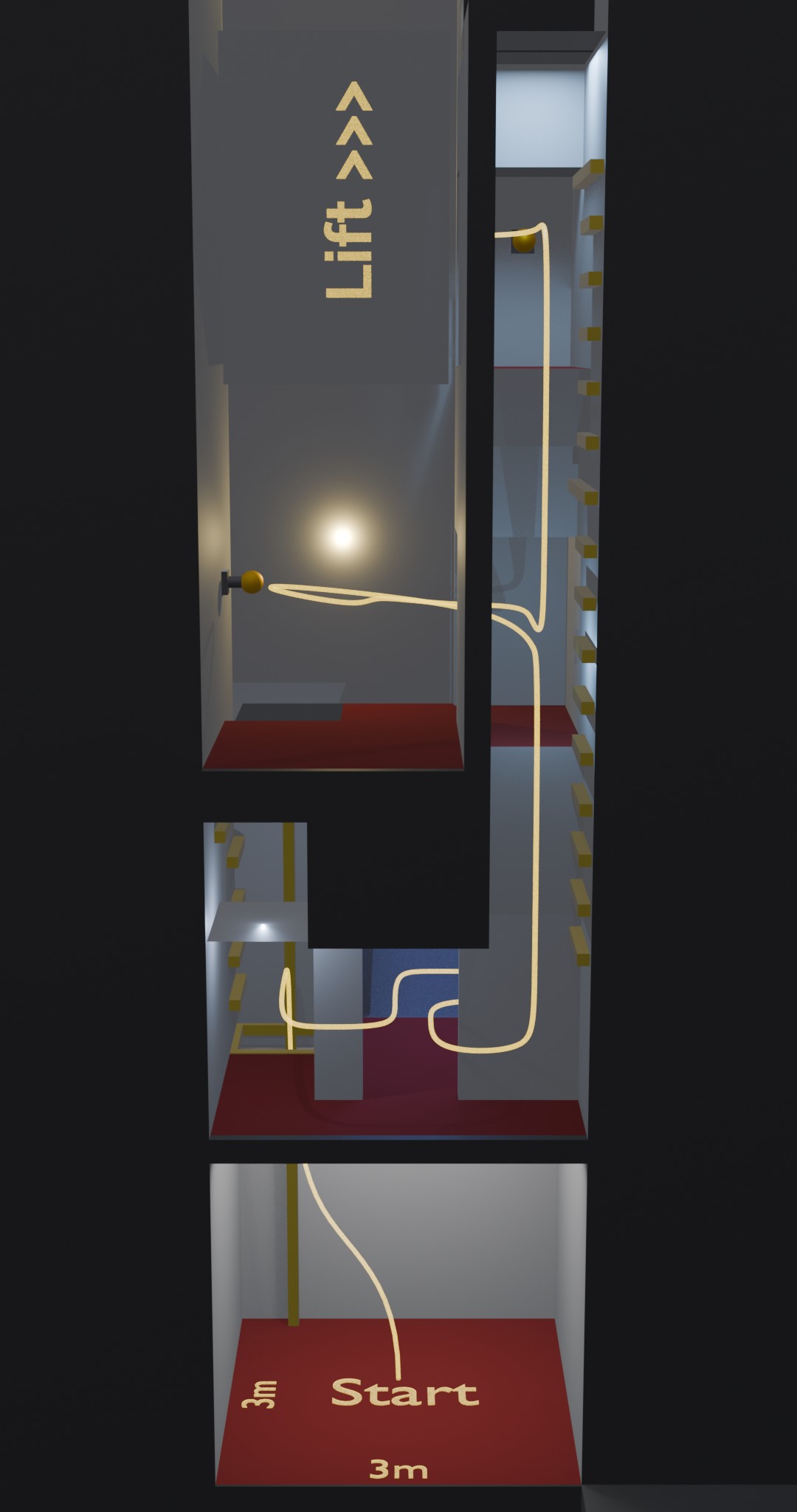
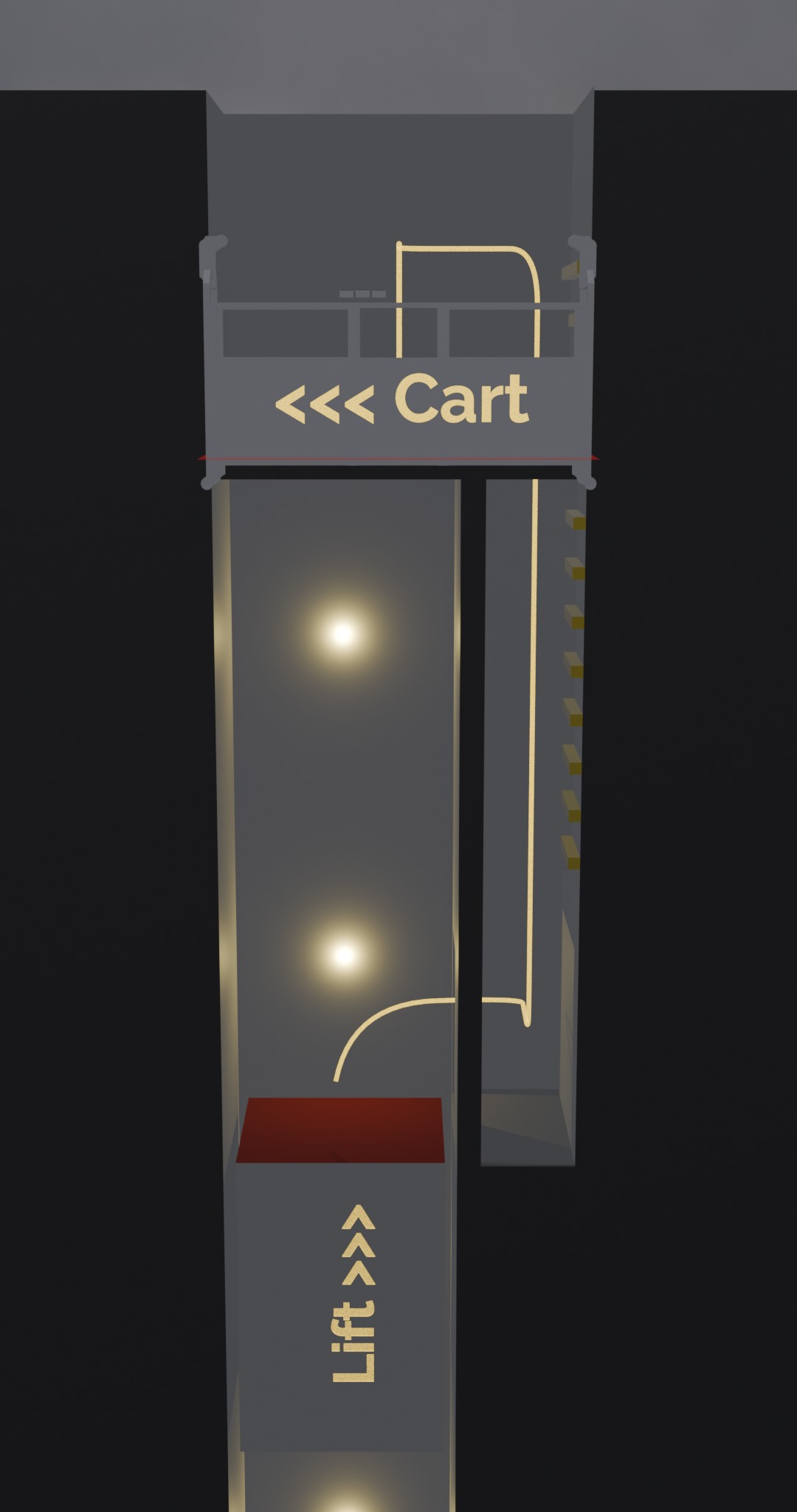
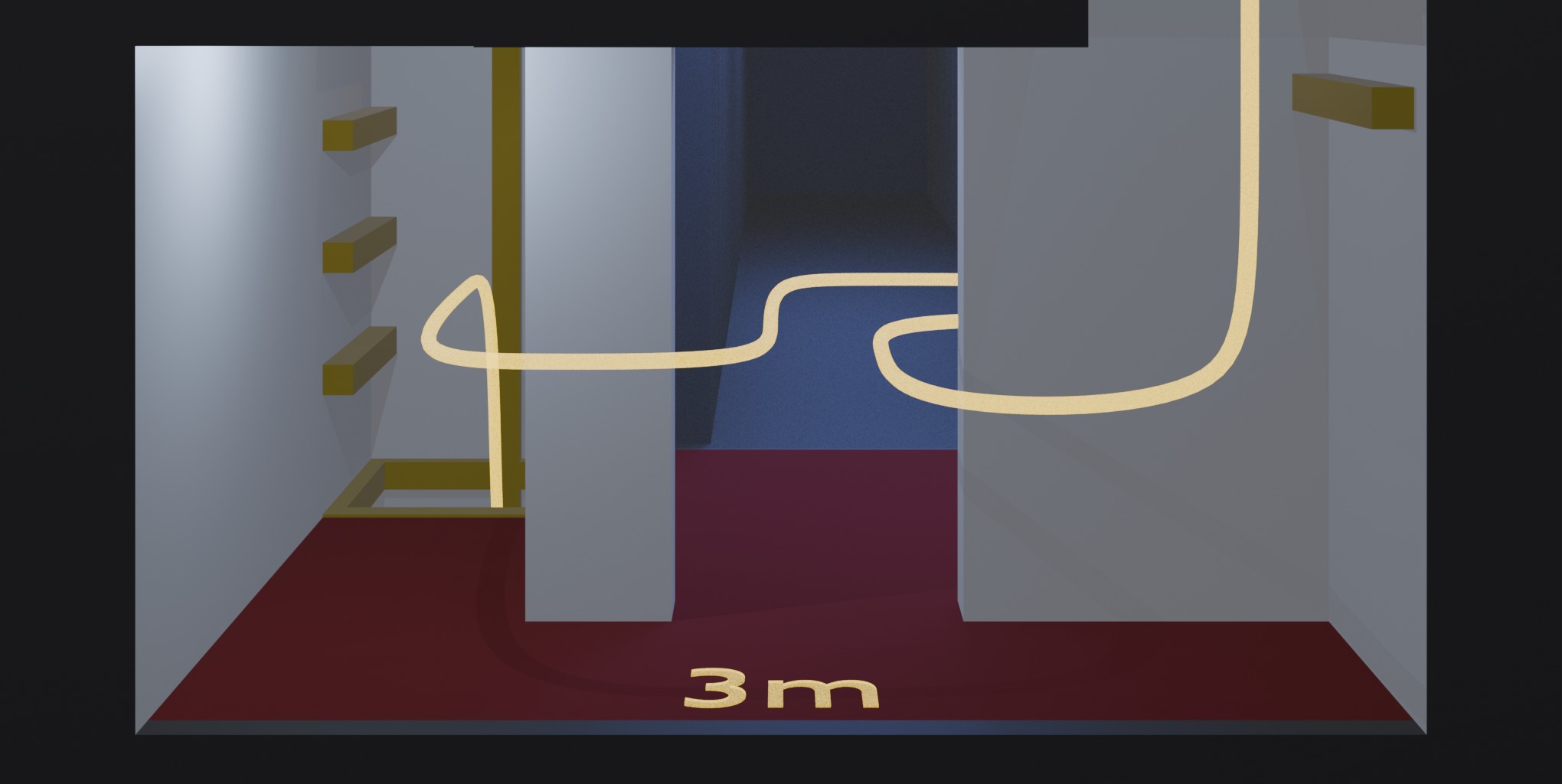
In the image, you can see an excerpt from our level concept, demonstrating an example arrangement of the interactions mentioned above.
The yellow lines represent the path the player have to go. The red areas indicate the walkable space, while the yellow elements represent interactive components such as ladders, ropes, and levers.
Spatial Illusion & Level Design
Next, we had to figure out how to give players the illusion of moving in a freely explorable world and not 'just' on 3x3 Meters. We also had to consider how to prevent them from wanting to leave the limited play area.
Here we drew inspiration from game design practices.
With thoughtful level and environment design, the virtual world can be built in such a way that players naturally want or need to stay within the limited interaction area. Objects and interactions guide them through the virtual world.
The simplest and clearest way is to use virtual walls. But relying only on this form is neither varied enough nor consistent with the goal of creating the illusion of an open world – so creativity was needed.
We will show you what this will look like in future Devlog articles. Let's just say this: falling from great heights can be unpleasant even in virtual worlds.
Conclusion & Outlook
This project has shown us that immersive brand experiences don't necessarily require huge locations or complex technology – but rather a well-thought-out concept, clear storytelling, and creative interaction design.
If you're curious, get in touch for a demo presentation.
Stay tuned for more stories from Immerstory.